 Mahjong Pages
Learn mahjong
Mahjong terms: a plain-English glossary
The words you will hear most at an American mahjong table are bam, crak and dot (the three suits), pung, kong and quint (three, four and five of a kind), the Charleston (the opening tile swap), exposure (a group shown on your rack) and wall game (a hand nobody wins).
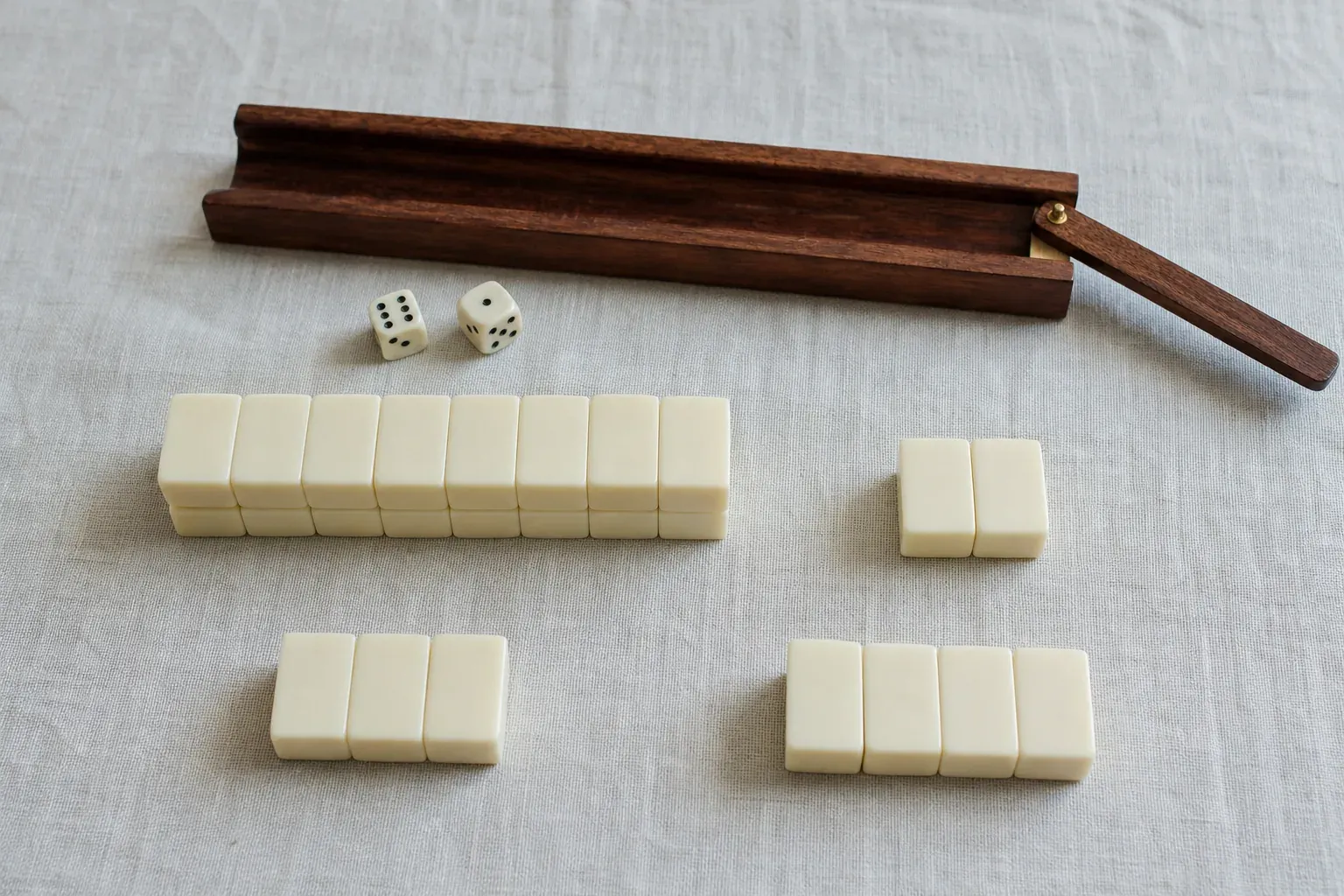
Last checked November 25, 2026.
Tiles
| Term | Meaning |
|---|---|
| Bam | A tile from the bamboo suit |
| Crak | A tile from the character suit |
| Dot | A tile from the circle suit |
| Wind | North, East, West or South tile |
| Dragon | Red, green or white honor tile |
| Soap | The white dragon. Also used as zero |
| Flower | One of eight flower tiles, all treated alike |
| Joker | A wild tile, usable in groups of three or more |
| Bird | The 1 bam, which is drawn as a bird |
| Honors | Winds and dragons together |
More detail in mahjong tiles: names and meanings.
Groups of tiles
| Term | Meaning |
|---|---|
| Single | One tile on its own |
| Pair | Two identical tiles |
| Pung | Three identical tiles |
| Kong | Four identical tiles |
| Quint | Five identical tiles, using at least one joker |
| Sextet | Six identical tiles, using at least two jokers |
| Chow | A run of three in one suit. Used in Chinese styles, not in American mahjong |
| Like numbers | The same number in different suits |
Setting up
| Term | Meaning |
|---|---|
| East | The dealer, who starts with 14 tiles |
| Wall | The row of stacked tiles in front of each player, 19 stacks long and 2 high |
| Rack | The holder for your tiles |
| Pusher | The arm attached to or used with a rack to slide the wall forward |
| Breaking the wall | Splitting East’s wall at the point shown by the dice, to start the deal |
| Hot wall | A table rule that limits discards once play reaches the last wall |
The Charleston
| Term | Meaning |
|---|---|
| Charleston | The exchange of three tiles at a time before play starts |
| First Charleston | Right, across, left. Required |
| Second Charleston | Left, across, right. Only if all agree |
| Blind pass | Passing on tiles you were just handed without looking, allowed on the first left and last right |
| Courtesy pass | An optional swap of up to three tiles with the player opposite |
| ROLLOR | Memory aid for the order: right, over, left, left, over, right |
Full walkthrough in the Charleston explained.
During play
| Term | Meaning |
|---|---|
| Pick | To draw a tile from the wall |
| Discard | The tile you throw face up at the end of your turn |
| Call | To claim another player’s discard |
| Exposure | A group placed face up on top of your rack after a call |
| Concealed | Held in your hand, not shown |
| Joker exchange | Swapping a real tile for a joker in an exposed group |
| Redeem | Another word for taking a joker in an exchange |
| Dead tile | A tile that can no longer be called, such as a discarded joker |
| Dead hand | A hand that can no longer win, for example because of a wrong tile count or an impossible exposure |
| Jokerless | A winning hand with no jokers, which pays double |
The card
| Term | Meaning |
|---|---|
| The card | The National Mah Jongg League’s yearly list of winning hands |
| NMJL | National Mah Jongg League |
| X | Exposed hand. You may call discards |
| C | Concealed hand. You may only call the last tile |
| Section | A group of hands with a shared pattern |
| Singles and pairs | A section with no groups of three or more, so no jokers can be used |
See how to read the mahjong card.
Ending a hand
| Term | Meaning |
|---|---|
| Mahjong | The call you make when your hand is complete, and the name of a winning hand |
| Self-pick | Winning on a tile you drew yourself. All players pay double |
| Wall game | A hand with no winner because the wall ran out |
| Throwing | Discarding the tile another player wins on. The thrower pays double |
Styles of play
| Term | Meaning |
|---|---|
| American mahjong | The 152-tile game played from the League’s card |
| Hong Kong style | A 144-tile Chinese style with runs and no card |
| Riichi | Japanese mahjong, played with 136 tiles |
| Siamese | A two-player version of American mahjong where each player works on two hands |
| Open play | A session where anyone can turn up and be seated at a table |
| Guided play | Open play with a teacher on hand to help |
Spelling: mahjong, mah jongg or mahj?
All are the same game. Mahjong is the most common spelling worldwide. Mah Jongg, with two words and a double g, is the spelling used by the National Mah Jongg League and many American players. Mahj is the everyday short form.
Ready to hear these at a real table? Find a game near you.
Common questions
- What is a meld in mahjong?
- A meld is a completed group of tiles, such as a pung or kong. American players usually say exposure for a group that has been placed face up on the rack.
- What is it called when no one wins in mahjong?
- A wall game. The tiles in the wall run out before anyone completes a hand, nobody is paid, and the deal passes to the next player.
- What is the difference between a pung and a kong?
- A pung is three identical tiles. A kong is four identical tiles.